Skip to content


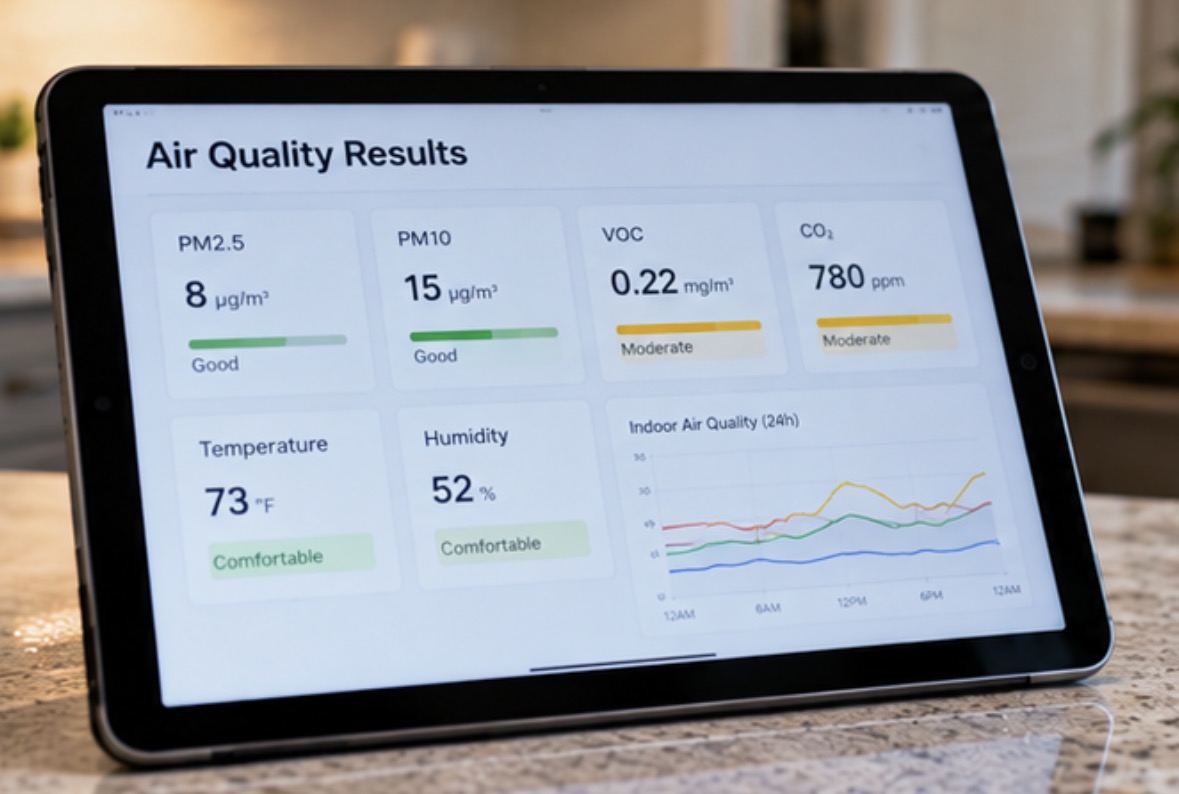
You bought a home air quality monitor, it flashed a high particulate or VOC number, and now you are staring at that reading with no idea what it means or what to do next. The device told you something is off without telling you what it is or where it is coming from. Acting on the wrong guess costs money, and this guide is here to help you read the number correctly.
The short answer: a home monitor and a professional air quality test answer different questions. A home monitor tells you that something is elevated right now, such as fine dust, VOCs, carbon dioxide or humidity, and it is useful for spotting trends over several days. It cannot identify mold, see inside your ducts, or trace where a reading comes from. A professional air quality test does that source-finding work, which is what turns a number into a fix.
What Can a Home Air Quality Monitor Actually Tell You?
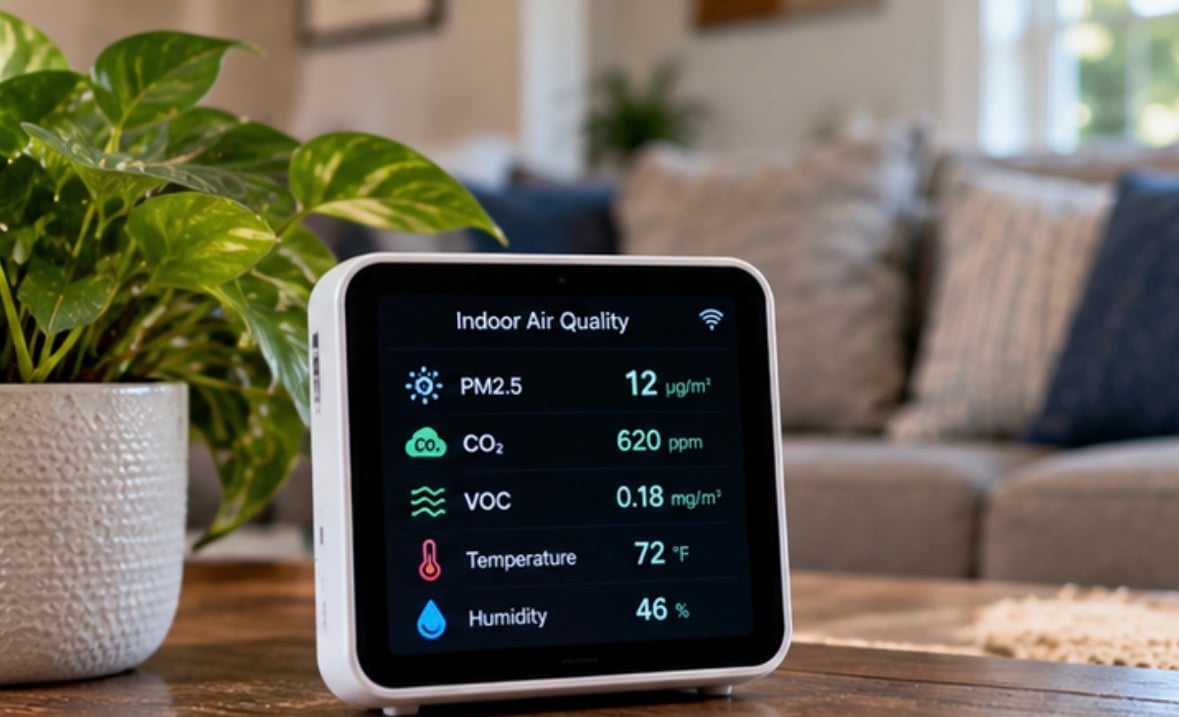
Most consumer monitors track four things reasonably well, and knowing what each reading means is how you avoid overreacting to a single spike.
Fine Dust and Particulates
Dust here means fine airborne particles, often reported as PM2.5, which are small enough to stay suspended and reach deep into your lungs. A monitor counts them, so a spike tells you particles are present. It does not tell you whether they came from cooking, a dusty vent, or something drifting in from outside, which is why a high number is a starting point, not an answer.
Chemical Fumes and VOCs
Volatile organic compounds are gases released by paint, cleaners, new furniture and flooring. A monitor flags a rise, which is genuinely useful right after a renovation or a deep cleaning. The reading tells you the air carries more of these compounds than usual, but it cannot name which one, so a brief spike after mopping is normal and a level that will not settle is the one worth noting.
Carbon Dioxide and Ventilation
Carbon dioxide is a proxy for how stale the air is. When people and pets breathe in a closed room, CO2 climbs, and a high reading usually means fresh air is not getting in. This one is easy to act on by opening a window or running a fan, and it rarely points to a hidden fault in the house.
Indoor Humidity
Indoor humidity is relative humidity, the share of moisture the air is holding against what it could hold. A monitor reports it accurately, and it is the reading that matters most through a long heating season. Too low and you get dry skin, static and cracking trim; too high and you risk condensation that feeds mold growth over time.
Reading your monitor over several days, not one moment, is what turns a number into a trend you can trust. A single reading catches a cooking spike or an open door, while a pattern across days tells you something steady is happening.
Keep in mind these are consumer-grade devices. The EPA describes low-cost air monitors as useful for trends but not regulatory-grade, so trust the direction more than the exact figure.
Where Does a Home Monitor Fall Short?
The device is honest about what it senses, but its blind spots are large, and most of them are exactly the things a worried homeowner wants answered.
A monitor detects conditions. It does not explain them. It can tell you particulates are high but not whether the source is a leaky return duct, settled dust blowing off the registers, or outdoor air. That gap between a reading and its cause is where guesswork and wasted spending usually begin.
The table below lays out what the device reads well against what it physically cannot do, and why that limit exists.
| What a monitor does | What it cannot do | Why the limit exists |
|---|---|---|
| Reports particulate, VOC, CO2 and humidity levels | Identify mold | It counts particles and gases; it cannot distinguish mold spores from ordinary dust |
| Shows trends over days | See inside the duct system | It samples the air in one room, not the hidden supply and return runs |
| Flags that a level is high | Trace the source of a reading | It measures a result, not where that result originated |
So the monitor is a smoke alarm, not an inspector. When a reading stays high and you cannot explain it, that is the point where a method built to find the source earns its place.
What Does a Professional Air Quality Test Find That a Monitor Can’t?
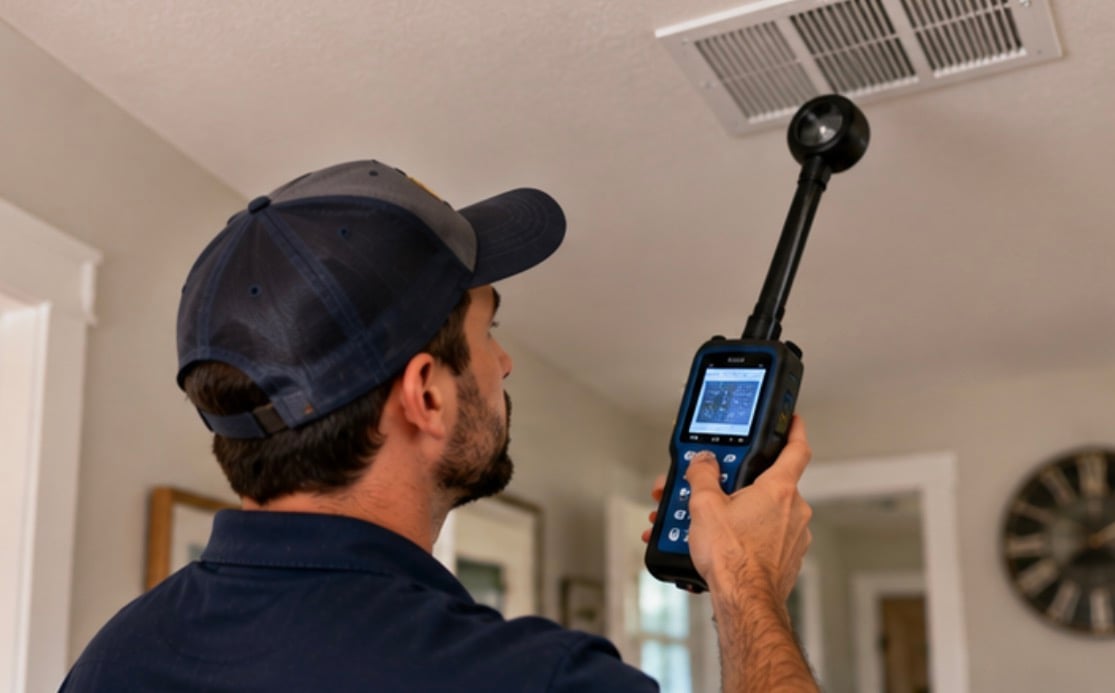
A professional test does the one thing a monitor cannot: it traces a reading back to its source. Where a device tells you particulates are elevated, a test and inspection work out whether the cause is inside the ductwork, a filtration gap, or growth somewhere the air passes through, so the fix targets the actual problem.
Mold is the clearest example. A general air monitor reads particulates and humidity, but none of its sensors can confirm mold, because spores register as ordinary particles.
Confirming mold takes sampling and a trained look at the conditions that let it grow. If you suspect it, how to know if air ducts have mold walks through the signs before you commit to any testing.
Inspection inside the system is the other piece. A monitor samples room air, while a technician can look at registers, returns and blower components where dust and moisture collect out of sight. Professional indoor air quality testing pairs that visual check with sampling so a reading gets an explanation, not just a number.
What this means for you is simple. A test is worth booking when a monitor reading has become a mystery you cannot solve by opening a window or changing a filter. It converts a persistent alarm into a specific cause, which is the only thing that lets you spend money on the right repair.
What Readings Should Make a Colorado Homeowner Book a Test?
Not every reading needs a professional. The trick on the Front Range is knowing which numbers are normal for this climate and which ones point to something indoors.
Front Range homes run dry once the furnace is on for the season, so indoor relative humidity sitting below about 30 percent for months is common, not an emergency. What matters is whether it causes problems you can feel, and whether filtration or a humidifier would help the air your family breathes all winter.
Wildfire smoke episodes also push outdoor particulates up for days at a time, so a fine-dust spike during a smoke event usually tracks the weather. The reading worth acting on is the one that stays high after the outdoor smoke has cleared, because that points to particles circulating indoors rather than drifting in.
Watch for these patterns before you call:
- Humidity stuck below 30 percent: If dry air is causing discomfort, indoor air quality equipment such as a humidifier may be the fix.
- Fine dust high after smoke clears: Outdoor particulates have settled but your reading has not, which suggests an indoor source.
- VOCs that will not drop after a renovation: Paint and new materials off-gas for weeks, but a level that never settles is worth tracing.
- A musty smell with no matching reading: Your nose catches something the sensors miss, often the first sign of hidden moisture.
The pattern that should move you from watching to calling is persistence. One bad afternoon is weather or cooking; a reading that holds across days, or a smell your monitor never explains, is the signal that a source needs to be found.
One thing worth noting: no general air quality test and no consumer monitor flags radon, which is a separate hazard with its own dedicated kit. Colorado has widespread elevated levels, so treat it as its own line item.
What Happens After a Professional Air Quality Test?
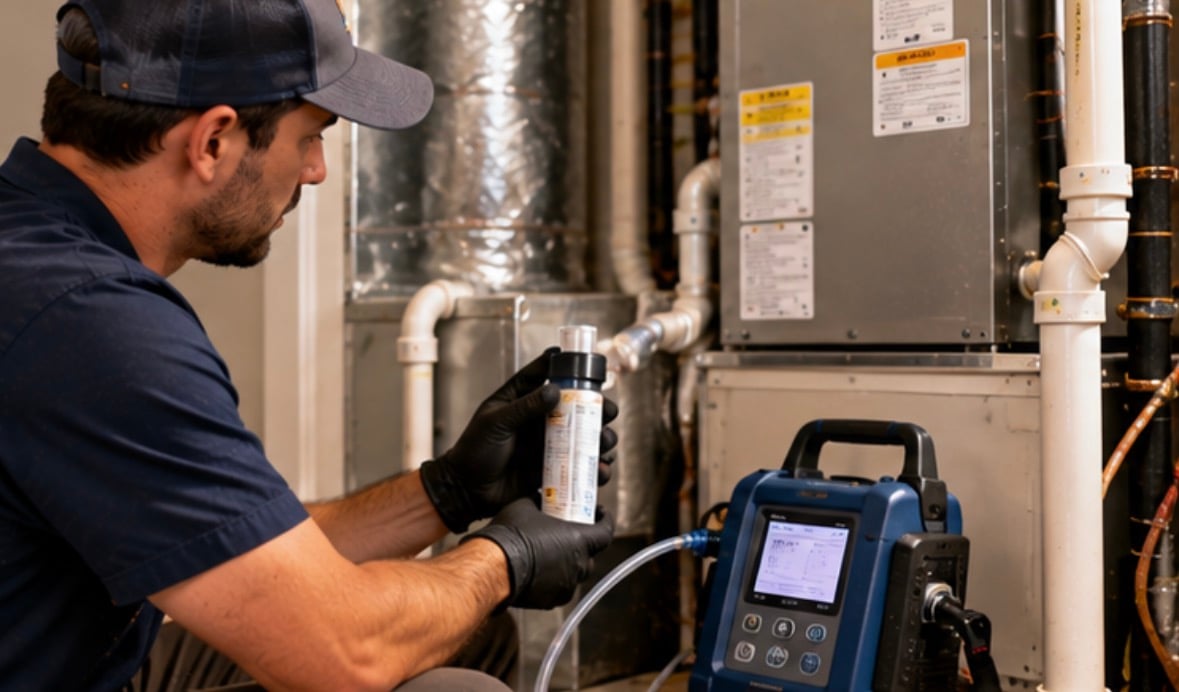
A test is not the finish line. It is the step that points at a specific fix, and the whole value of it is that you stop guessing and start correcting the actual cause.
Depending on what the test and inspection find, the result usually leads to one of these:
- Duct cleaning: Air duct cleaning removes buildup from supply and return ducts, registers and blower components, using HEPA negative-air machines and rotary brushes.
- Disinfection or mold remediation: Duct disinfection or mold remediation when sampling confirms biological growth in the system.
- Humidity correction: A humidifier or filtration upgrade when winter air is running too dry or too wet.
- Better filtration: A higher-efficiency filter, or an air cleaning system with HEPA filtration, matched to what your system can move air through.
- A UV system: Ultraviolet light installed in the air handler to disrupt biological growth before it spreads.
Keep your monitor running after the work is done. A reading taken only beforehand tells you what you had; readings over the following days tell you whether the fix moved the number, which is the proof that your money did what it was supposed to. Before-and-after photos of the system show you what was removed. [CLIENT TO CONFIRM: do you offer a post-cleaning air test?]
Why Choose Fresh Air First for Indoor Air Quality in Northglenn?
Fresh Air First is an owner-operated indoor air quality and duct cleaning company in Northglenn, with a 4.9-star rating across more than 200 Google reviews. We work with homeowners in English and Spanish.
When a monitor reading will not settle, we start by finding the source. Our indoor air quality testing pairs air sampling with a look inside the system, and we photograph what we find so you see the same thing we do. If the answer is duct cleaning, disinfection or better filtration, we explain why before recommending it, and if it is simply ventilation, we tell you that too.
The in-home inspection is free, and you get the exact price before any work begins. Call (720) 740-0836 or send us a message to book it.
Frequently Asked Questions
Are cheap air quality monitors accurate?
Low-cost monitors detect trends well but are not regulatory-grade, so treat the direction and persistence of a reading as reliable and the exact number as approximate. The EPA notes these devices do not meet the accuracy standards of instrument-grade equipment. That does not make them useless; a monitor that consistently shows rising dust is telling you something worth noting, even if the precise figure is off.
Can a monitor detect mold?
No. A general air monitor reads particulates, VOCs, humidity and carbon dioxide, and none of those identify mold, because spores simply register as more particles. A musty smell with no matching reading is one of the most common signs, and confirming mold takes sampling rather than a sensor.
Should I test before or after duct cleaning?
Both have value. A reading before the work shows what you are dealing with, and a reading after shows whether the cleaning actually moved it. Your own monitor can track the after picture over the following week, and before-and-after photos of the ducts show what was removed.
Does an air quality test check for radon?
Not usually, and no consumer monitor flags it. Radon is a colorless, odorless radioactive gas, and according to the EPA’s guide to indoor air quality, there is no way to tell whether it is present without measurement. It needs its own dedicated test left in place over time. Most Colorado homes should test for it, and the state radon program offers low-cost kits made for the job.
How many days should I watch my monitor before acting?
Give it several days rather than reacting to one reading. A single high number can come from cooking, cleaning products or an open window. A level that stays elevated across days, or recurs at the same time each day, is the pattern that is worth acting on.